History of the Hermès logo
History of the Hermès Logo: Alfred de Dreux's Duc Attelé
1837: a saddler, not a luxury house
In 1837, Thierry Hermès founded a workshop in Paris specializing in the creation of harnesses and saddles for the city's elite. Its quality earned it a first-place award at the Paris Universal Exhibition in 1867.
At that time, Hermès was not yet a luxury house. It was an artisan business whose first client was the horse and the second, the rider. This phrase, spoken much later by Jean-Louis Dumas, sums up the entire DNA of the brand.
The drawing that changed everything: Alfred de Dreux
In the 1920s, Émile-Maurice Hermès acquired a pencil and white gouache drawing titled "Le Duc Attelé, Groom à l'Attente" (The Harnessed Duc, Groom Awaiting) signed by Alfred de Dreux.
The Duc Attelé depicts a Petit-Duc, an open four-wheeled carriage with a removable hood, which its owner could drive from the inside. In the drawing: a magnificent harnessed horse, and a groom in a top hat and tailcoat awaiting the arrival of his passengers.
Alfred de Dreux was no ordinary illustrator. He was one of the most famous animal painters of the 19th century. His horses have a presence, a life, and a rare quality in the academic painting of the time.
1945: the logo becomes official
Officially registered as a trademark in 1945, the horse and carriage became Hermès' signature.
The original Hermès logo was produced in black on an ivory background with a gold border. During World War II, material shortages meant that only bright orange cardboard was available for packaging. Adopted out of necessity in 1942, the Hermès orange box quickly became a symbol of luxury and modernity. Initially printed with black text only, the Hermès logo was added in 1950, transforming this packaging into an emblem.
The 1970s: refinement
After its introduction in 1950, the horse and carriage logo was refined in the 1970s, adopting a more minimalist approach. This updated version, known as the Duc Carriage, simplified the lines of the horse, carriage, and groom, giving the emblem a more elegant and modern appearance.
It was also in the 1970s that the name Hermès in capitals was added below the Duc Carriage, in an elegant serif font.
What the logo says about Hermès
Every detail of the Duc Attelé carries a precise meaning.
The horse: depicted proportionally larger than the groom, it recalls that power is at the heart of Hermès' savoir-faire.
The Petit-Duc: Not an imposing royal carriage, but an elegant car that its owner drives himself. An important nuance: Hermès luxury is personal, intimate, never ostentatious.
The waiting groom: patience, service, attention paid to the customer even before their arrival. A philosophy of service that spans centuries.
Alfred de Dreux is part of the Hermès legend
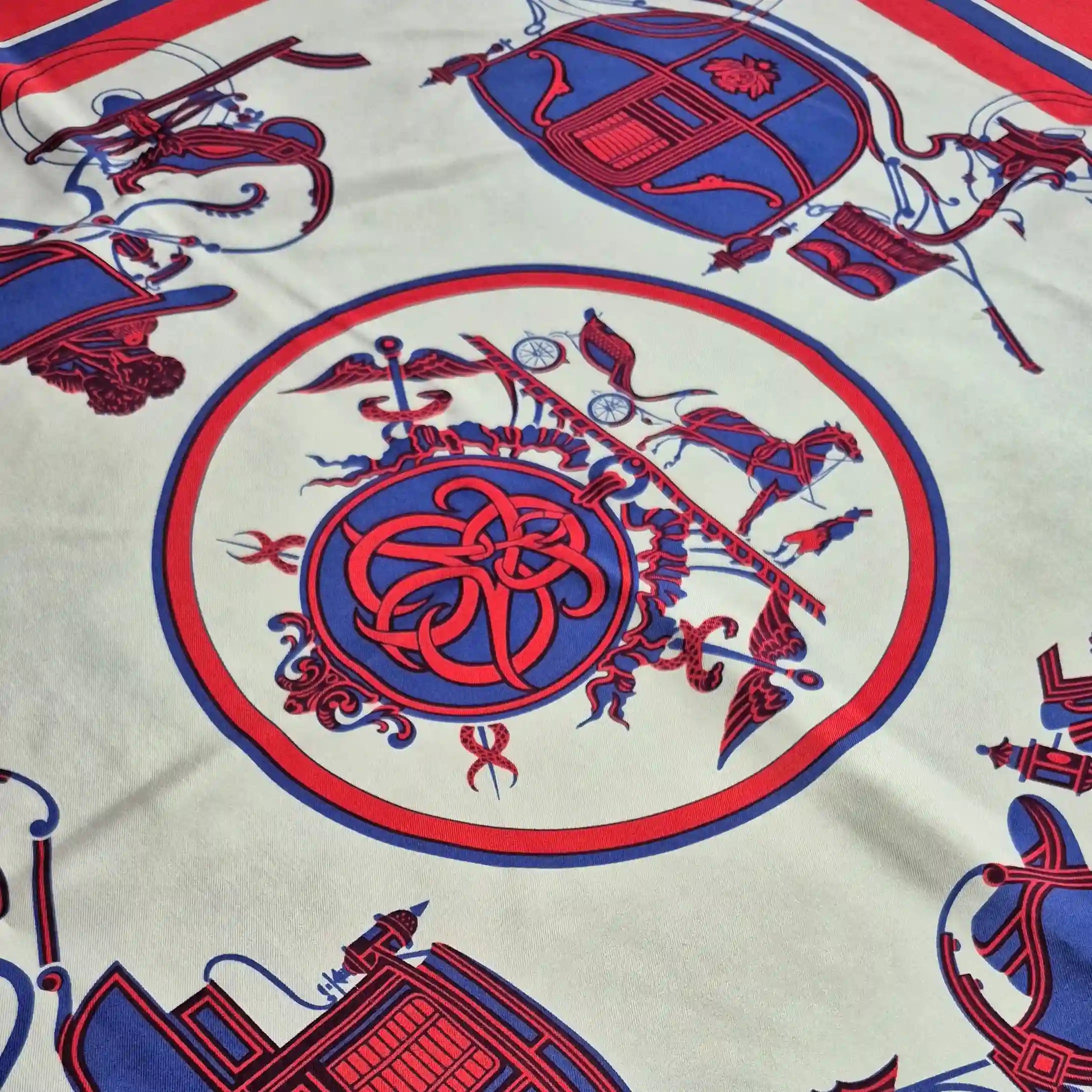
The House of Hermès allowed Alfred de Dreux to enter into legend not only through the use of his Duc Attelé as a logo, but also by entrusting Zoé Pauwels, in 1992, with the creation of a scarf in his name: "Alfred de Dreux, peintre de chevaux" (Alfred de Dreux, painter of horses).
The orange box: an accident that became an icon
The Hermès orange box was adopted in 1942 out of necessity, as wartime shortages meant that only orange cardboard was available. What was a constraint became one of the most recognizable luxury symbols in the world.
Today, the orange box is as famous as the logo itself. Receiving an orange box has become a universal signal of luxury, regardless of what it contains.
A logo that doesn't change
The Hermès logo reflects the brand's equestrian beginnings, paying homage to its heritage. Compared to contemporary logos that favor minimalism and abstraction, Hermès remains faithful to its classic design. This contrast underscores the brand's unique positioning in the luxury market.
In nearly 80 years, the Duc Attelé has never fundamentally changed. When the whole world was simplifying, streamlining, modernizing, Hermès kept its horse and its groom.
Frequently Asked Questions
What does the Hermès logo represent? The Hermès logo depicts a Petit-Duc harnessed to a horse, with a groom in a top hat waiting. It is inspired by a 19th-century drawing titled "Le Duc Attelé, Groom à l'Attente" by the animal painter Alfred de Dreux.
Who created the Hermès logo? The Hermès logo is inspired by a drawing by Alfred de Dreux, a French animal painter born in 1810. It was Émile-Maurice Hermès who chose it as the official logo of the House, officially registered in 1945.
How long has Hermès been using this logo? The horse and carriage logo was officially registered in 1945. It was added to the orange box in 1950, then refined in the 1970s with the addition of the name Hermès in capitals.
Why is the Hermès box orange? The Hermès orange box originated from a wartime constraint in 1942; shortages meant that only orange cardboard was available. What was a necessity became one of the most recognizable luxury symbols in the world.
What is the font of the Hermès logo? The font used for the name Hermès is a slightly modified version of Memphis Medium.
What is a Petit-Duc? A Petit-Duc is an open, four-wheeled carriage with a removable hood, which its owner could drive from the inside. There is also a Grand-Duc version. This is the vehicle featured on the Hermès logo.