The Legend of Kermit Oliver
Kermit Oliver: The Texan Designer Who Revolutionized the Hermès Scarf
He sorted mail at night in Waco, Texas, as a U.S. postal worker. By day, he painted watercolors on paper, the exact dimensions of a silk scarf, rolled them up, and mailed them to Paris. Between 1984 and 2014, Kermit Oliver created seventeen scarves for Hermès.
Who is Kermit Oliver?
Born on August 14, 1943, in Refugio, Texas, Kermit Oliver is the first American artist to create designs for Hermès. From childhood, while his father worked as a cowboy on a ranch, Kermit's talent for drawing cattle, horses, and Texas wildlife was already evident.
After university and with the mentorship of painter John T. Biggers, Kermit quickly established himself in the Houston art scene and became the first Black artist represented by a major commercial gallery in Houston.
The Encounter with Hermès:
The relationship with Hermès began in 1980 when the House sought an American artist capable of creating a design with a Southwestern theme. It was Lawrence Marcus, son of the Neiman Marcus co-founder, who recommended Kermit Oliver to Jean-Louis Dumas, then Hermès' artistic director.
What immediately appealed to Marcus was that Oliver conceived his paintings from the outside in, starting with the frames. And this is exactly how Hermès had always conceived its scarves!
For his first commission, Oliver chose to depict a Pawnee chief, and when Dumas saw the first design, he declared: "Kermit, we must not stop there. We must continue."
Kermit Oliver's Hermès Scarves: A Texan Universe on Silk
Each of Oliver's scarves is a work of deep research. A single design could take him an entire year to conceive. His process was entirely artisanal.
His Most Iconic Creations
Pani La Shar Pawnee (1984), the first scarf. A proud Pawnee chief, surrounded by references to Karl Bodmer's illustrations of the American West.
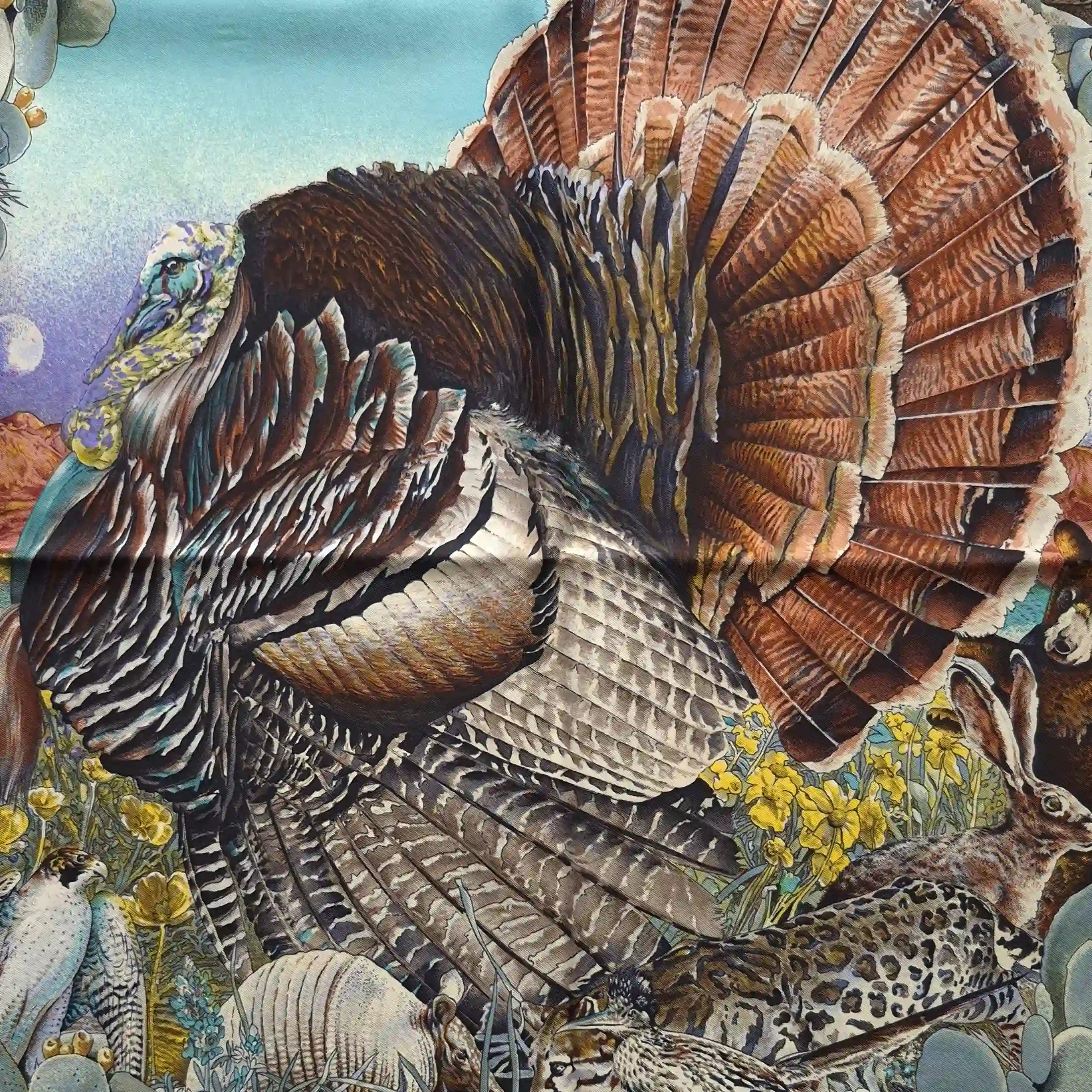
Faune et Flore du Texas (1987) created for Texas's 150th anniversary. Over 50 native animals coexist on this 90x90 cm silk scarf, with an iconic wild turkey at its center.
Kachinas (1992) A kaleidoscope of ceremonial Hopi dolls dancing against a backdrop of vibrant colors.
Les Cheyennes (1993) Renamed Plumes de l'Ouest (Feathers of the West) after protests from the Cheyenne Nation regarding the use of its name.
Madison Avenue (2000) A Native American woman surrounded by flora and fauna on Manhattan Island, created to celebrate the 10th anniversary of the Hermès flagship in New York.
A Discreet Artist
Kermit Oliver does not like publicity. He does not attend exhibition openings and rarely gives interviews. He prefers to stay at home. He did not even attend the inauguration of the exhibition dedicated to him at The Bryan Museum in Galveston in 2025, the first to bring together all seventeen of his scarves in one place.
Why are Kermit Oliver's Scarves So Sought After?
In the vintage market, Hermès scarves signed by Kermit Oliver hold a special place. Their rarity, narrative dimension, and roots in American history make them unique collector's items.
For collectors, owning an Oliver is possessing a fragment of an improbable story: that of a humble man who, between postal rounds, designed some of the most beautiful silks ever produced by the House of Hermès.