How to Authenticate a Real Hermès Scarf?
How to spot a real Hermès scarf from a fake: the complete guide
Authentication is essential
The Hermès scarf is one of the most counterfeited luxury accessories. In the secondary market, fakes stand alongside genuine items, sometimes with alarming similarity.
1- The first test: does this model exist?
It's obvious, but when you start exploring the world of Hermès scarves, there are simple pitfalls to avoid.
2) The second test: the feel
A real Hermès scarf is first distinguished by its material: a dense, heavy twill silk, with a fluid yet stable drape. The brand uses its own silk, up to twice as thick as the average.
The touch test is immediate: Hermès silk has a particular density that no counterfeit I've handled so far has faithfully reproduced. The weave also has a diagonal relief perceptible to the touch and visible. Furthermore, if you can't distinguish the diagonal weave of your scarf, it's not authentic.
3) The hand-rolled hem
This is a reliable and easy-to-check criterion. The edge of an Hermès scarf consists of a hand-rolled hem. If it is machine-made or rolled incorrectly, it's a fake. The corners of an authentic hand-rolled hem should also be checked; on fakes, the corners are often rough.
4) The print
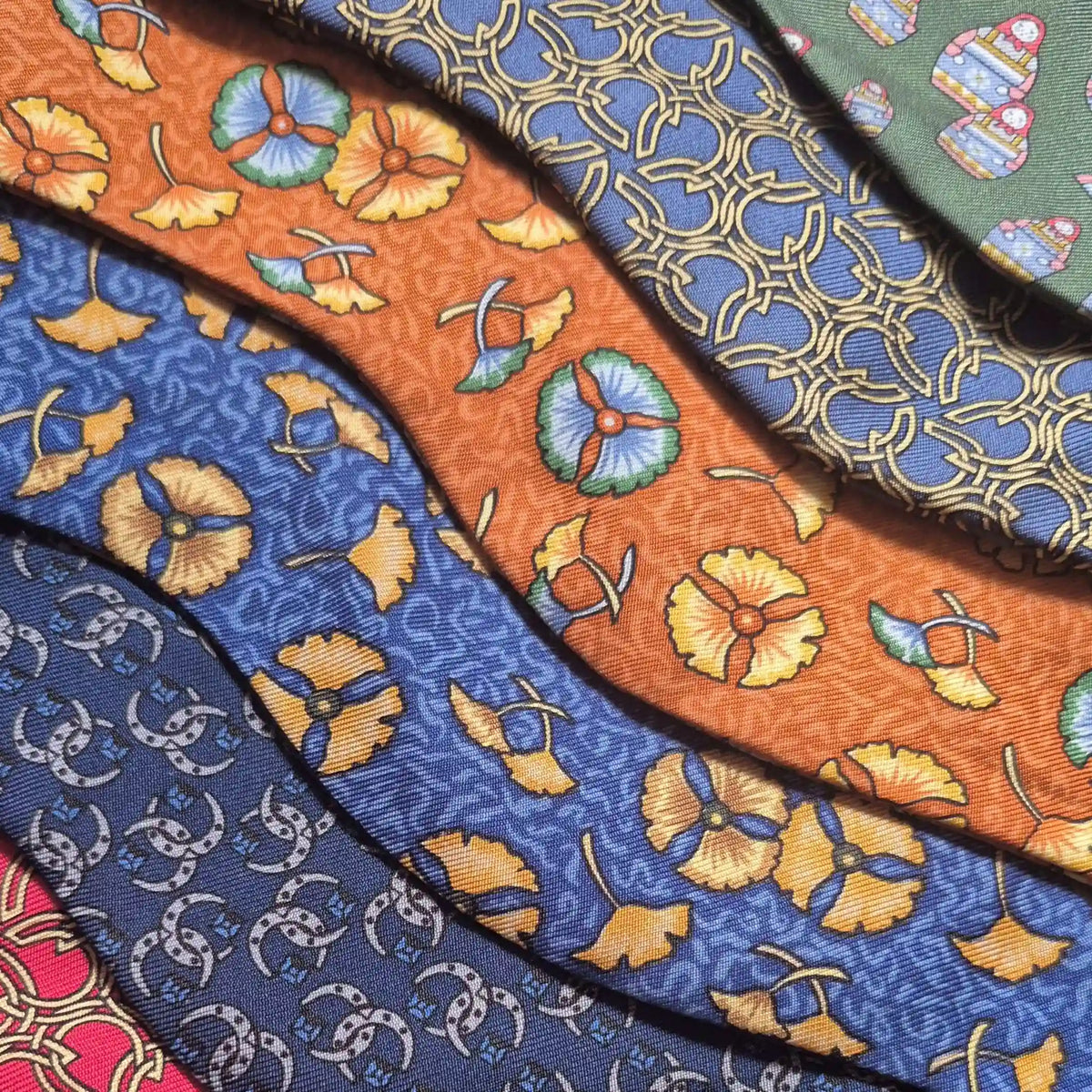
The Hermès print is fine, clear, with no smudges or overflows. The colors are vibrant, the outlines sharp. On copies, you often notice blurriness, misalignments, dull printing, or a lack of contrast. Note, however, that not all old authentic items are perfectly sharp; this is where the expertise of professionals is important.
Moreover, the design on the scarf is always perfectly centered. If you look at your scarf and it's off-center, there's a problem.
5) The Hermès signature
The Hermès signature, along with the Copyright (if present), must be properly aligned with its grave accent over the "e".
6) The label, if present.
Hermès labels have varied over time. I won't go into the different labels and their years of issue here. It is crucial that the label, if present, is well-woven, that the letters are aligned, and that there are no spelling errors. Finally, it must be sewn correctly.
7 — The orange box: not a sufficient guarantee
Hermès scarves are usually sold in a distinctive orange box. Be careful, however, as counterfeiters may use real Hermès boxes to sell fake scarves. The presence of a box does not mean that your scarf is authentic. The fake boxes I have handled have a smooth surface and sometimes an off-center logo.
Summary: the 7 checkpoints
|
Criterion |
Real |
Fake |
|---|---|---|
|
Hand-rolled hem |
Hand-stitched, invisible, fine V-shape |
Machine-stitched, regular, square corner |
|
|
Sharp, no smudges |
Blurry, dull, misaligned |
|
Signature |
Aligned |
Missing accent |
|
Weave |
Visible diagonal |
Absent |
|
Model |
Original |
Non-existent |
|
Label |
Woven, "Made in France" |
Counterfeit |
|
Box |
A real box remains a reassuring sign. |
Counterfeit box, very high suspicion indicator. |
Frequently Asked Questions
How to recognize a real Hermès scarf? The main criteria are the hand-rolled hem with invisible stitches, the diagonal weave visible to the touch, and the HERMÈS signature.
How to check the hand-rolled hem of an Hermès scarf? The authentic hand-rolled hem is made by hand on the right side of the scarf. The stitches are invisible and regular, and the corners finish in a very fine V-shape. A hem rolled incorrectly or made by machine indicates a counterfeit.
Is a vintage Hermès scarf without a label necessarily fake? No. Many owners remove the label. For scarves from before the 1980s, the absence of "Made in France" or copyright is normal. Authentication then relies on the weave, the hand-rolled hem, and the quality of the print.
Does the orange Hermès box guarantee the authenticity of the scarf? No. Counterfeiters use real Hermès boxes to sell fakes. The box is an element of context, not a sufficient authentication criterion.
Every scarf in our selection of vintage Hermès scarves is examined against these criteria before being put up for sale.