
Article: Brides de Gala: The story of the world's most iconic Hermès scarf

Brides de Gala: The story of the world's most iconic Hermès scarf
1957: a motif born from a gesture
Paris, 24 rue du Faubourg Saint-Honoré. The year is 1957. Robert Dumas, who has been leading the Maison since 1951, is working with Hugo Grygkar on the creation of the next carré. At some point during the day, Dumas places two sumptuous harnesses from Émile Hermès's personal collection face-to-face on the floor, and the realization is immediate: the idea is right there before them.
Since 1957, one design, 30 reinterpretations. This is the record of Brides de Gala: the best-selling, most re-edited, and most renowned carré in the Maison's history.
Hugo Grygkar: the artist behind Brides de Gala
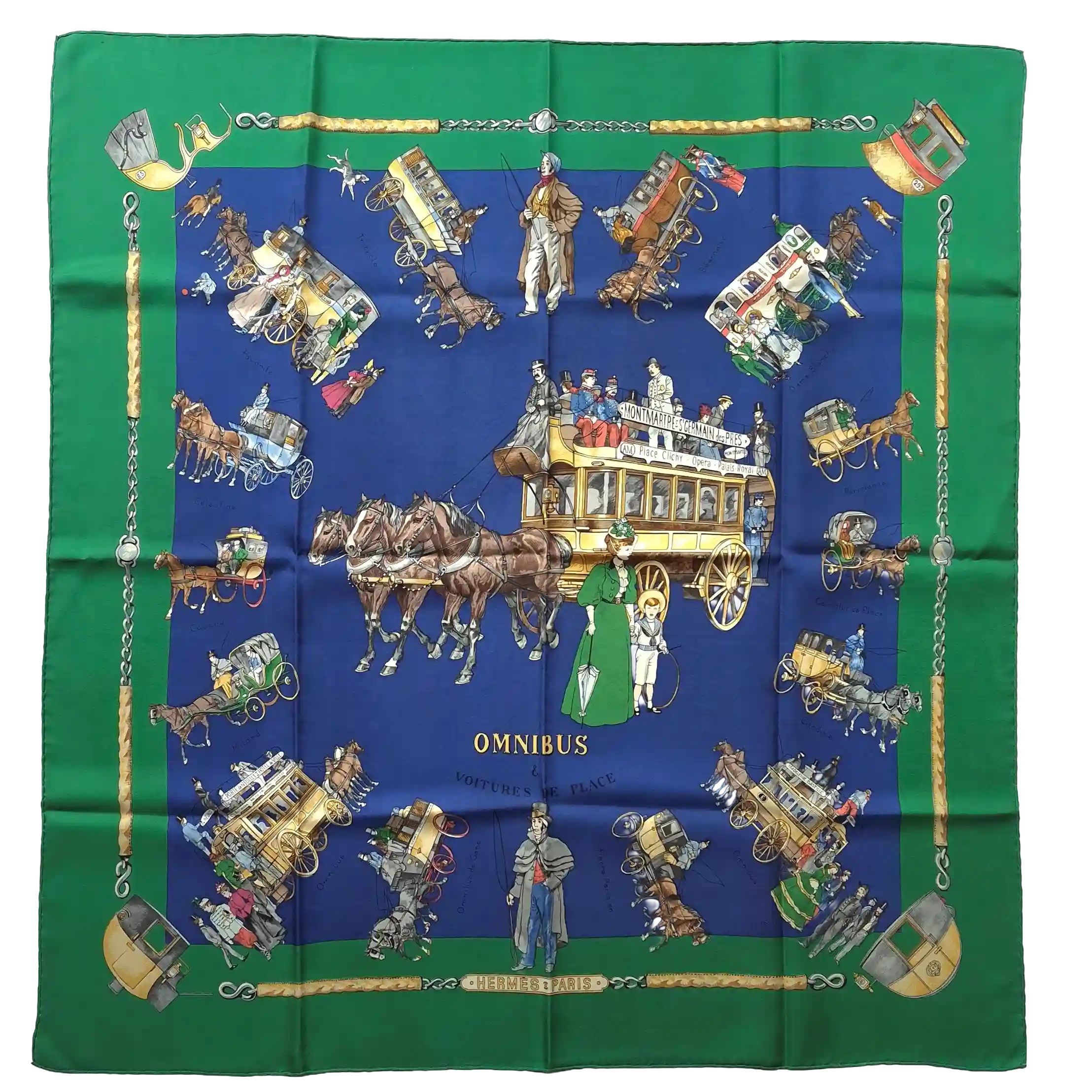
Born in 1907, Grygkar joined Hermès in the 1930s and quickly became the Maison's lead carré designer. He designed more than 60 carrés between 1937 and the 1970s, including the first carré in the Maison's history, Jeu des Omnibus et Dames Blanches, in 1937. Discover his complete career in our article dedicated to Hugo Grygkar.
But Brides de Gala is the classic that, now, everyone knows.
Why Brides de Gala has never aged
It is worth asking. How does a design created in 1957 remain so contemporary 70 years later?
It probably lies in its structure. Brides de Gala is a geometric and rigorously symmetrical carré. This rigor allows it to adapt to all colors, materials, and formats without ever losing its identity.
Hermès says it itself: it is one of the Maison's emblems and everything is permitted to it. Whatever whims transform it, it retains the originality and intensity that make it unique and instantly recognizable.
The 30 reinterpretations: a story within a story
Brides de Gala was re-edited for the first time in 1967, before being revisited many times: Brides de Gala Love, Tattoo, en Désordre, and many other variations.
Each reinterpretation is an opportunity to experiment with a new technique or color, with the most striking versions being:
Brides de Gala Désordre (2003): an interpretation under the direction of Cyrille Diatkine, where the harnesses break free from their original symmetrical appearance to scatter freely across the silk. A deliberate departure from the rigor of the original design.
Brides de Gala Tattoo (2017): printed in white on a monochrome background. Grygkar's design revisited as a contemporary engraving.
Brides de Gala Wash: hand-washed using an exclusive process, this carré can then be machine-washed. A major technical innovation for the Maison.
Brides de Gala Dip Dye (2010): gradient dyeing treatment. The first time Hermès applied this technique to this motif.
Brides de Gala Love: the motif placed in an orange heart-shaped Hermès box, a collector's edition.
Brides de Gala en Fleurs: special edition in the Carrés Précieux collection, embellished with floral embroidery.
Brides de Gala Double Face (2020): thanks to the double-sided printing technique developed in secret for 5 years, the same motif is printed in two different colors at once on the front and the back.
Sophia Loren, 1957: the beginning of a long list
The very year of its creation, Sophia Loren is photographed with a Brides de Gala. This first link between the carré and an international icon launched a tradition that has never been interrupted.
Brigitte Bardot, Jackie Kennedy, Catherine Deneuve, Queen Elizabeth II, they have all worn Brides de Gala at one point or another. This list of illustrious wearers reinforces every decade the legitimacy of a carré that, however, never needed it.
Brides de Gala on the vintage market: what you need to know
Not all Brides de Gala are equal; here are a few characteristics to help you tell them apart.
Age: the editions from the 1960s and 1970s are the rarest. The silk from that era has a softer feel than recent editions.
Color: for the same motif re-edited in dozens of colors, some were produced in more limited quantities.
Special edition: Brides de Gala Love, Harrods editions, or other exclusive orders command higher prices.
and of course: condition.
Brides de Gala in figures
| Year of creation | 1957 |
|
First re-edition |
1967 |
| Number of re-editions. |
30+ |
| Available formats | 90cm, 70cm, Twilly, Bandana |
Frequently asked questions
What is the Hermès Brides de Gala carré? Brides de Gala is the most iconic carré in the Maison's history. Created in 1957 by Hugo Grygkar, it depicts two ceremonial harnesses from a set that belonged to Maximilian of Austria, Emperor of Mexico. It has been continuously re-edited since then and counts more than 30 reinterpretations.
Who created Brides de Gala? Brides de Gala was created by Hugo Grygkar in 1957, in collaboration with Robert Dumas, director of the Maison Hermès. Grygkar is the lead artist at Hermès who also designed the first carré in the Maison's history in 1937.
How many versions of Brides de Gala exist? More than 30 official reinterpretations, including Brides de Gala Tattoo, Wash, Dip Dye, Love, Désordre, Fleuries, and Double Face, not to mention the dozens of different colors produced for each version.
Why is Brides de Gala so popular? Its rigorous symmetry allows it to adapt to all colors and materials without losing its identity. It is also inseparable from Hermès's equestrian history.
More great equestrian classics await you in our selection of vintage Hermès scarves.
